
Odd & Even Numbers


What is it
A set of worksheets designed to help children understand, identify, and apply the concept of odd and even numbers through visual, hands-on, and structured activities. These worksheets support early numeracy skills, logical thinking, and school readiness.
Teaching Objectives
Understand the concept of odd and even numbers
Memorise odd and even numbers from 1–10
Learn and recognise the sight words “odd” and “even”
Improve mental math
Follow multi-step worksheet instructions
How to use
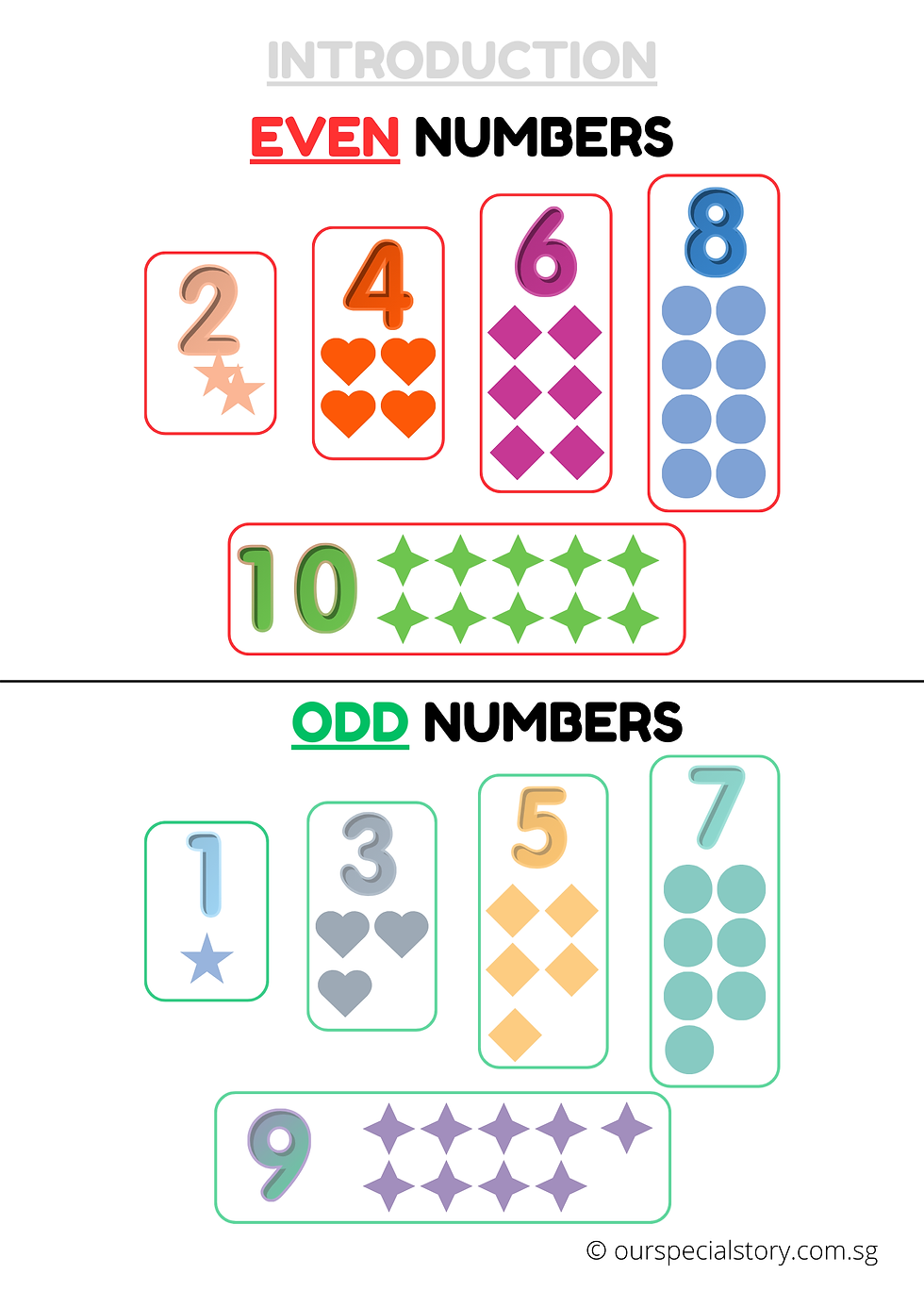
1) Introduction:
Start by explaining that odd numbers cannot be shared equally, while even numbers can.
Go through numbers 1-10 together.
2) Fill in the blanks:
Use this activity to help your child memorise which numbers are odd andeven. Say the numbers out loud and repeat often.
3) Cut & Sort:
Let your child cut out the numbers and physically sort them into odd and even groups. This helps children see and feel the difference, making learning more concrete and fun!

4) Matching:
Look at each number and decide whether it is off or even, then match it to the correct category.
Encourage your child to say their answer out loud to strengthen understanding.
5) Colour/ Circle all odd/ even numbers:
These activities help your child identify odd and even numbers one by one among many numbers.
Guide them to check carefully before colouring or circling.
This builds attention, visual scanning, and number recognition skills.

6) Count & Circle:
These activities combine counting, number writing, and decision-making.
Ask your child to count the items, write the numbers, then decide if it isodd or even.
Seeing and choosing the correct word also helps your child learn andrecognise the sight words “odd” and “even”, while checking their overallunderstanding of the concept.
Teaching tips
Always read the instructions aloud together before starting
Encourage your child to count out loud and explain their answers
Use real-life examples (e.g. “We have 2 shoes — even!”)
Repeat activities across different days to build confidence
Praise effort and participation, not just correct answers
Here are some videos that can help with teaching the concept:
Embed more learning opportunities
Receptive language –
“Point to the odd number”, “Show me an even number”, “Which one is even?”
Expressive language –
Ask your child to verbalise:
“Is 5 odd or even?”
“What number is this?”
“Why is it odd?”
-Specially created by Our Special Story-
Our Special Story provides Home Based 1-on-1 ABA Therapy, Early Intervention Class, School Readiness Class, Social Skills Class and School Shadowing for children with autism spectrum disorder, speech delay and other special needs.
ABA Therapy can help to improve behaviours, attention, speech and communication,cognitive skills, motor skills, school readiness, social skills, self help skills and more!
#freeprintables #schoolreadiness #earlyintervention #ourspecialstory #abatherapy #socialskills #autism #specialneeds #autismsingapore #specialneedssingapore #preschoolactivities #ourspecialprintables #differentiatedlearning


Comments